While it’s a myth that men are the only perpetrators of gender-based violence (GBV), the fact remains that violence by men against women is by far largest category of offences.
In spite of this—or because of this—men have an important role to play in leading the way out of the cycles of violence.
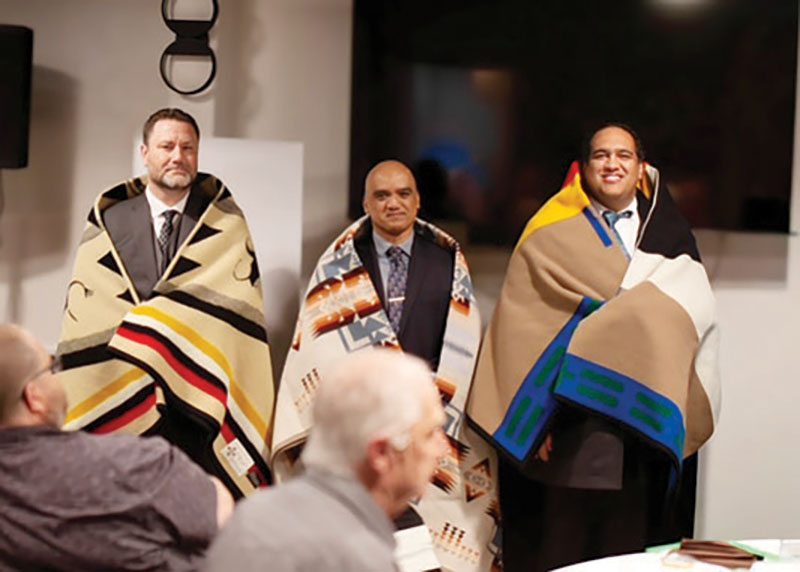
Bonnyville Friendship Centre (BFC) hosted a conference titled “Men Leading Men,” a community roundtable on gender-based violence, on March 20. Bonnyville – Cold Lake – St. Paul MLA Scott Cyr, RCMP Staff Sergeant Lloyd Pinsent, and Pastor Grant Lottering were the invited speakers.
Elders, community members, service providers, industry partners, frontline workers, and media representatives participated in the roundtable. More than 50 people attended.
Gender based violence is any form of harm—physical, emotional, sexual, financial, or psychological—that is rooted in power, control, and inequality. “It includes the obvious forms of violence, but it also includes the quieter ones: threats, intimidation, humiliation, manipulation, and fear,” said Angie Papillon, BFC’s mental health coordinator.
“GBV is not just about single incidents. It is about patterns of behaviour that make someone feel unsafe, controlled, or silenced,” Papillon said.
She said children and youth are experiencing some of the highest rates of gender based violence in the country, and not just as witnesses—many are direct victims of physical, sexual, and emotional abuse as well as exploitation and controlling behaviour.
A local survey found personal experience of GBV is consistently high among people from birth to age 34.
“Seniors are also deeply impacted, often in ways that go unnoticed,” Papillon said. “Older adults may face emotional abuse, financial control, neglect, or intimidation from family members or caregivers. Many seniors are isolated or dependent on others, which makes it harder for them to speak up or seek help.”
Papillon and BFC CEO Janet Gobert stressed that the conference wasn’t about blaming men or holding men specifically responsible for violence, but seeking ways for men to lead other men on the issue.
“We invited strong male advocates and community leaders because change requires leadership,” Papillon said. “When men understand what GBV looks like, when they speak up, when they model respect, when they interrupt harm, the culture around them shifts. Boys learn from the men they watch. Communities follow the tone set by their leaders.
“And when men lead with integrity, accountability, and compassion, violence decreases.”
In her opening remarks Gobert said, “I stand before you at a point of reflection, an impasse in many ways. We have built supports, we have created spaces, but we know there is more to be done.
That is why we are here together.”
She asked the conference participants for guidance. “Each one of you brings something valuable into this space, your perspectives, your experiences, and your knowledge. That is our strength,” she said.
“Tonight is not about blame. It is not about pointing fingers. It is about coming together in a spirit of collaboration, respect, and shared responsibility… We simply need your help.”
Papillon said the Friendship Centre will host more sessions in the coming months.