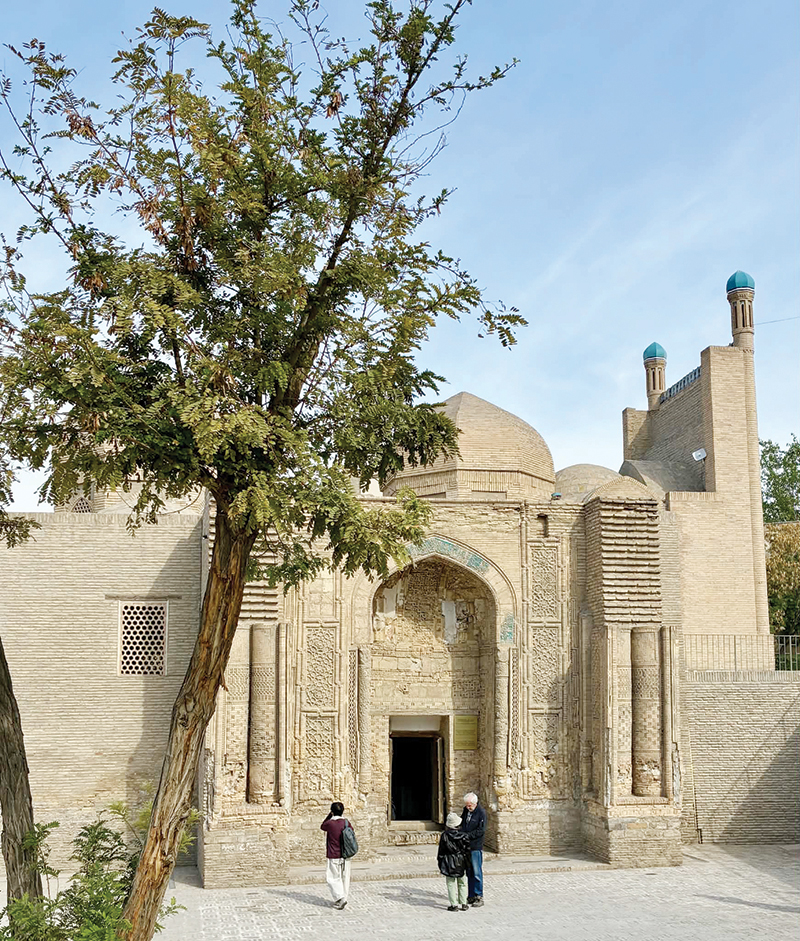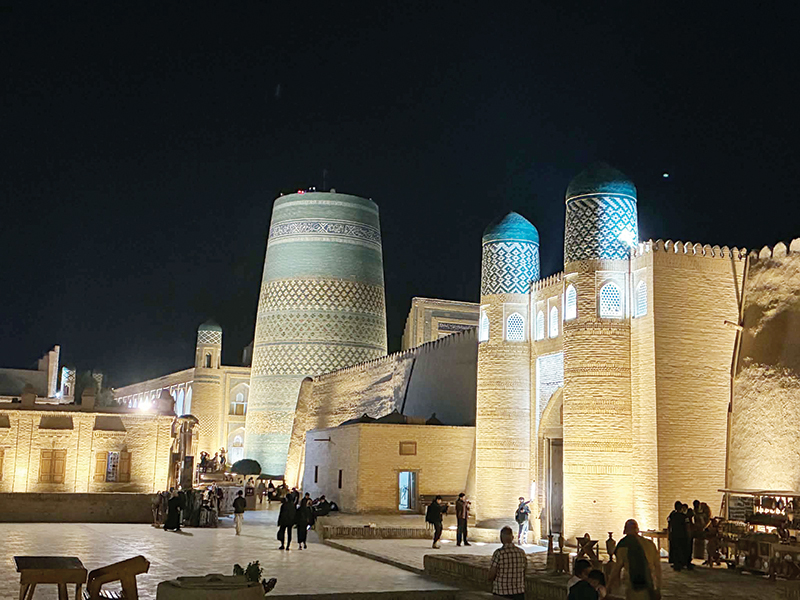
“The Silk Road” is an evocative notion, and redolent with imagery. It is, in fact, not a single passage from Europe to China, but a vast network of roads and tracks, cities and waypoints that lubricated the east-west trade of the first 15 centuries of the last millennium. Of the nearly 6,500 kilometres of identified track, I have chosen to look at the 400 kilometres of the network between Bukhara and Khiva in Uzbekistan.
This is desert country; no landscape for sissies. Scrub, sand, dust, and a flat plain lying for hundreds of kilometres in any direction. Yet travellers passed through in large numbers, and cities sprang up to meet their needs and relieve passers-by of any surplus wealth.
Bukhara and Khiva are magnificent places. Their architecture is breathtaking, the development of the communities inspiring, and their resilience in the face of climatic, political, and religious conflict is remarkable.
And they are well worth visiting.
I had previously visited Uzbekistan in 2017, but then only to Tashkent and Samarkand. It was a trip that left me puzzled and keen to dig a little deeper.
I finally returned last week. Some of the questions I left with have been answered, but I am still left with an overwhelming feeling of having been a participant in an elaborate, and very well dressed, performance.
The Soviets are, of course, to blame.
From the mid-1920s until 1992 Uzbekistan was a part of the USSR, a regime not noted for its protection and safeguarding of historical sites. Mosques and madrassas were painted white and used for storage; monuments’ paint peeled and bricks disintegrated. Seventy years of neglect virtually destroyed two thousand years of development.
And that seemed to be the course of my discomfort.
The entirety of Uzbekistan’s history was refurbished and restored by teams of local and Chinese artisans over a twenty-year period, and the resulting patina leaves little or no distinction between the 4th or 16th century buildings. The architecture is spectacular, and of course the differences in age are obvious, but there is always a slight suggestion of a theme-park.
A very nice one, to be sure, but the singular restoration of multiple eras leaves a slightly destabilized feeling.
There are a lot of tourists here. Uzbekistan is very much an “in” place it seems. Visitor numbers for the first nine months of 2026 exceeded all
of 2025 by 35 per cent, and they all seem to be here. The vast majority come from neighbouring countries with Kyrgyzstan oddly leading the way. Mostly family visits, I was told, and a result of the Soviet governments shuffling people around for decades.
Then there are the others. Russians by the score, Spanish and Italian visitors following guides holding their country flags, and Chinese tourists by the busload. To accommodate these numbers many old houses in the city’s centre have been converted into “boutique” hotels. Small—often with only ten or so rooms—they are comfortable, moderately priced, and universally friendly.
Central Asia is a fabulous place to explore. “The Stans,” as they are a trifle dismissively referred to, are all as different as one can imagine. Different economically, politically, and geographically, but all offering visitors a fascinating glimpse into a history rich in stories, people, and culture.
The Silk Road is an evocative concept; one that I love. In a week or so I shall be back to Georgia and yet another important stop on this ancient, absorbing and prosperous network. It is an extraordinary system of connections that still resonates in the 21st century.
Globetrotting appears exclusively in Respect. For more Max, visit www.maxglobetrotter.com