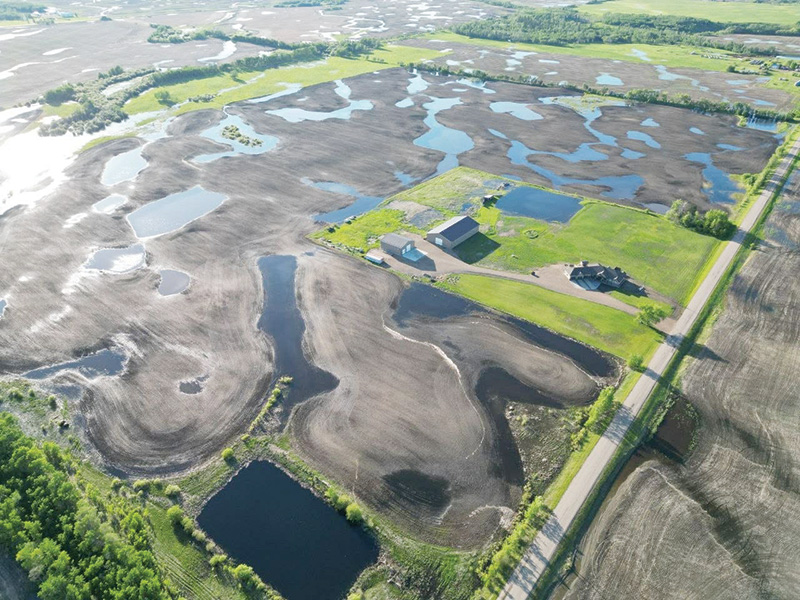
A slow start to seeding is putting the 2026 crop year at risk for some local farmers. A late thaw and a lingering rainy season have shortened the growing season, and some fields are still too wet to get the seeds into the ground.
“The growing season was delayed to start with. Winter hung on a little bit and then it was really wet,” said Vern Slonowski, who farms in St. Paul County. “And this moisture that’s continued on, at least in our Lakeland area, has delayed the general seeding progress.”
The delay is already costing producers. Higher-value crops like wheat and canola require a full growing season to mature for harvest. According to Lloydminster-based grain marketing consultant Sarah Davis, some affected farmers have changed their plans and opted for lower-value crops, like barley, that don’t need as long to grow.
Which farms and which fields are affected is very localized, Davis said. Even within a given region, rainfall can vary, and water accumulation depends on the specific terrain.
“There’s been a different amount of rainfall in different locations, but seeding in general is quite a bit later this year overall,” Davis said. “And there are ag retail locations—the retailer I talked to is in Saskatchewan, I’m sure it’s everywhere—that are getting canola seed returns as well as chemical returns, just from growers switching their seeding plans to something that has a shorter growing period.”
Slonowski said he’s seeing it in his part of St. Paul County. “It did have some effect on some of the producers’ choices of crops that they wanted to grow. They’ve had to adjust that a little bit, and in turn that might adjust what they might make for revenue in the fall,” he said.
Not all of the risk is because of the delay. Some of it stems from there being just too much water.
“Ground conditions are still very wet. To say a crop is seeded is one thing, but some of the crop might be drowned out or some might continue to feel the effects of too much water,” Slonowski said.
“Plants don’t necessarily like too much water. If it doesn’t kill them, it could reduce the yield and in turn reduce the farmers’ income.”
Davis says most producers around Lloydminster have been able to deal with the moisture and have even welcomed it. But just a little bit west, she says. it’s too much. “St. Paul is in that boat, Vegreville is in that boat, and I think Bonnyville is probably close there as well.”
Slonowski said he and his neighbours were on the land this weekend, hoping to seed as many acres as they could before the cutoff for crop insurance eligibility. That deadline was extended to Saturday because of the wet conditions.
But they are planting in hopes of harvesting a crop this year, not making an insurance claim.
“The producers certainly don’t want to have to rely on the insurance system for their income. It’s not going to be as good as if they had grown a respectable crop on their own,” Slonowski said.
Davis agrees crop insurance can mitigate losses, but the farm generally doesn’t break even on a claim.
“The spring insurance price in Alberta for red spring wheat is well under $8 a bushel, and most farmers need above $8 a bushel to break even,” she said.
Producers buy the insurance based on how much of their typical yield they want to insure. If they
buy 80 per cent coverage, crop insurance will pay them for up to 80 per cent of their average yield—but sometimes at a lower-than-market price.
“So they’ll cover 80 per cent of your normal wheat yield at say $6.80 a bushel,” Davis said, “but even if they were covering 100 per cent of your yield, that’s still not a break-even price.”
Slonowski said farmers understand they’re in a risky business. He says they’re not begging for sympathy, but he feels it’s important for people to understand that the fortunes of a family farm can affect the availability and price of food for everyone. And the farm economy is an important contributor to the overall economy of rural communities.
He holds out hope that some of the growing season can be salvaged—with a little bit of luck.
“For an entire season we need some sunshine, some warm weather, and a little bit of rain in the perfect balance,” he said.
“That’s the risk most ag producers have to always endure, every year. The weather’s not necessarily always going to be providing each of those ingredients in a timely fashion.
“But right now, probably the number one thing in our area is just getting some sunshine for more than a few days.”